
Introduction: Core Values of Stewardship of Public Trust and Commitment to Public Good
Written by: Evy Vannoy and Laiqa Walli, Partnership for Public Service
Leading in the public sector comes with a unique set of opportunities, challenges and organizational dynamics. Many traditional leadership principles only partially address the specific experience of working in government. Particularly at the county level, public service leaders must deliver on a wide variety of community needs, all while navigating the regulations, policies and procedures of state and federal government.
At the Partnership for Public Service, we recognize that good leaders are fundamental to government’s ability to meet the challenges of today and tomorrow. In a world of complex problems, effective leaders spark innovation and drive change, steward vital public resources and enable employee success, ensuring that government organizations across the U.S. meet the needs of those they serve.
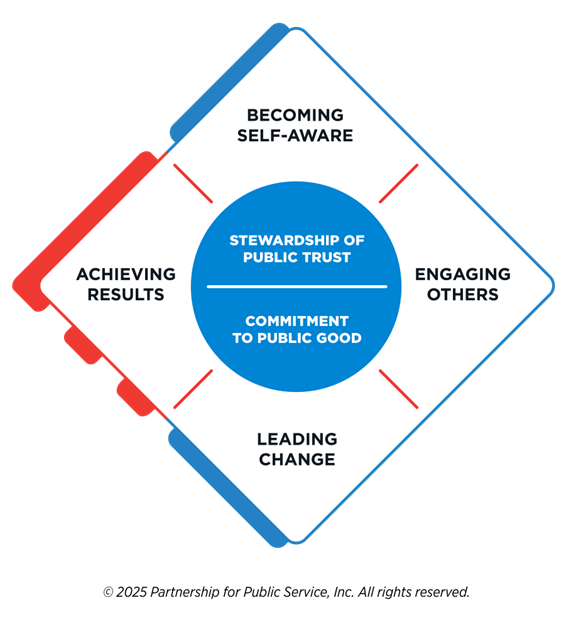
The Public Service Leadership Model®, a standard of effective government leadership.
The Public Service Leadership Institute® crafted the Public Service Leadership Model® to offer a standard of effective government leadership. The model is based on our experience working with tens of thousands of government employees and contributions from leadership luminaries on our Government Leadership Advisory Council.
At the heart of the model are two core values: Stewardship of Public Trust and Commitment to Public Good. Success in government is tied to mission objectives that serve the public and, to lead effectively, public servants must embrace these values. Public service leaders are entrusted by the American public to steward government’s resources, power and influence with integrity. Furthermore, the mission of public service is rooted in producing outcomes that benefit the public good. These two core values, unique to government service, act as a true north for public service leaders working for the American people.
In addition to anchoring leadership in two core values, the Public Service Leadership Model features four competencies: Becoming Self-Aware, Engaging Others, Leading Change and Achieving Results. Each competency contains five key skills, or subcompetencies, that are essential to effective public service leadership.
Becoming Self-Aware
Becoming Self-Aware is about knowing how your values and motivations drive your behavior. The subcompetencies for Becoming Self-Aware are Self-Reflection, Authenticity, Emotional Intelligence, Integrity and Continuous Learning.
Self-Reflection
Self-reflection is the practice of looking inward with honesty and intention. Consistent check-ins on how you lead, recognizing how factors like stress, fatigue or excitement shape your behavior, and learning to manage your energy helps you respond with clarity rather than reactivity. To practice self-reflection, set aside time to ask yourself meaningful questions, examine assumptions you might take for granted and notice how past experiences influence your reactions in the present.
Self-reflection is both an individual and a relational process: Deep insight comes from your own introspection as well as from the perspectives of people who see your leadership in action. Seeking, and thoughtfully integrating, feedback from colleagues, mentors and stakeholders can illuminate blind spots and highlight strengths you might overlook. Understanding yourself more deeply enables you to lead with greater intention, steadiness and purpose.
Authenticity
Authenticity means acting in alignment with your values, which creates an environment of transparency and trust. Public servants today are inspired by leaders they relate to and genuinely connect with—leaders who prioritize sincerity and empathy.
Being authentic begins with identifying your values and core beliefs about leadership. Examine how these internal beliefs show up in your behavior, including seeking feedback from others who can reflect your observable leadership qualities back to you. Understand how to integrate vulnerability in a genuine way that enables you to connect with others. Avoid comparing yourself to others—each person possesses their own unique leadership presence. Try some leadership or personality assessments to clarify your values, strengths and behaviors at work. Authenticity will bloom when your leadership and behavior align with your inner values and sincere personality.
Emotional Intelligence
Emotional intelligence, or EQ, is the ability to recognize your own emotions and those of others, and then to use that awareness to guide behavior in productive ways. As leaders grow in emotional intelligence, they build stronger relationships, navigate challenges with empathy and create environments where people feel understood and supported.
EQ is made up of four key components: self-awareness and self-management, which together form your personal competence, and social awareness and relationship management, which shape your ability to relate to and collaborate with others. Developing EQ starts with curiosity—paying attention to what you feel, how those emotions influence your actions and how you might use this awareness to productively regulate your actions. Tune in to your self-talk, notice your body language during meetings and reflect on how you impact others. At the same time, strengthen your social EQ skills by practicing active listening, asking clarifying questions and validating others’ perspectives.
Integrity
Integrity is the steady practice of aligning your choices, even when they may be difficult, to your values. Leading with integrity asks that you pause to consider the weight and impact of your decisions as well as the example they set for people you lead. Leaders who act with integrity create environments where honesty is expected and ethical concerns can be voiced without fear, fostering daily interactions that build trust.
This work begins with knowing your own moral compass. What do you stand for? How do those principles show up in your leadership? Practicing integrity also requires humility: admitting mistakes, re-examining assumptions and strengthening relationships through transparency. Over time, integrity becomes less about a single decision and more about a consistent pattern of behavior that communicates reliability, cultivates mutual respect and reinforces the idea that acting in alignment with values is a nonnegotiable part of your leadership.
Continuous Learning
Continuous learning is the commitment to keep expanding your skills and perspectives, allowing each success or setback to shape you into a more capable, adaptable leader. Continuous learning encompasses both formal professional development and on-the-job learning, including asking questions, exploring new tools and staying aware of how evolving technologies and circumstances influence your work. Integrate habits that support long-term development, such as seeking mentors, practicing mindfulness to stay present during challenges and setting ambitious goals.
Leaders who embrace continuous learning treat failure as information, not limitation, and lean into feedback as a tool for progress. Cultivate personal perseverance, understanding that your leadership grows through discomfort and sustained effort. As this mindset becomes part of your leadership identity, you not only become a more effective leader, but you also signal to your team that learning is valued, adaptability is essential and improvement is an ongoing journey rather than a singular destination.
Engaging Others
Engaging Others involves collaborating effectively, whether by fostering individual relationships, working with a team or leading an organization. This skill requires the subcompetencies of Relationship Building, Empowering Others, Conflict Management, Collaboration and Fostering Engagement.
Relationship Building
Relationship building is the ability to connect with others, foster trust, and create a supportive and collaborative environment. Strong work relationships matter because they enable teamwork, increase engagement and expand influence across networks, helping you achieve goals more effectively.
Leaders who build real relationships communicate openly and show genuine interest in others’ perspectives and needs. These leaders build trust by approaching interactions with authenticity and integrity. Strengthen this competency by spending a few minutes in meetings connecting on a human level and practicing active listening, including asking people open-ended questions. Try to understand others, support their growth and recognize their contributions—these behaviors create a workplace where collaboration and mutual respect thrive.
Empowering Others
Empowering others means giving people the autonomy, trust and support they need to take ownership of their work. Leaders who empower others create an environment where individuals feel valued and capable, which motivates them to contribute their best ideas. Empowering others begins with recognizing the strengths and potential of your team members and providing them with opportunities to grow. Delegation is key. Entrust others with meaningful responsibilities and give them the authority to make decisions—this boosts confidence and a sense of personal accountability.
Practice this competency by offering professional development opportunities, inviting input and healthy debate, and coaching team members through challenges rather than quickly solving problems for them. When leaders share power and empower others, they build more productive teams who take pride in their work and drive collective success.
Conflict Management
Conflict Management means addressing disagreements and counterproductive behavior in a way that fosters understanding and productive collaboration. Leaders who manage conflict effectively create a psychologically safe environment where differing perspectives are respected and challenges are constructively navigated. These leaders approach conflicts with curiosity and a growth mindset, viewing them as opportunities to learn, innovate and strengthen relationships.
Practice the skill of conflict management by seeking to understand the perspectives of all parties and using structured approaches to resolve disagreements. Your strategies may include providing calm, clear feedback, setting new expectations and collaboratively determining next steps. When leaders handle conflict thoughtfully and respectfully, they build collective trust to encourage open dialogue and maintain a culture where diverse ideas flourish.
Collaboration
Collaboration entails working together toward shared goals, ensuring everyone understands their role and contribution. Leaders who collaborate understand the stakeholders needed to achieve results and invite various perspectives into the decision-making process. They also set norms for how stakeholders engage with each other, share information transparently and create space for healthy dialogue and debate. In addition, they break down silos across and within teams and seek opportunities to cocreate solutions.
Effective collaboration is especially important in government because responsibilities often span different organizations, and engaging communities is essential to delivering better outcomes for the public. When leaders model collaboration by valuing input, sharing credit and promoting mutual accountability, they cultivate workplaces where teamwork thrives and collective success becomes the norm.
Fostering Engagement
Fostering engagement means building engaged teams and a work environment where all people can be successful. As a leader, if you establish a foundation of mutual respect and make others feel valued for their unique perspectives and merits, you will unlock untapped creativity and talent.
When people do not need to expend undue energy on dodging incivility or proving they belong, they can focus on contributing their best work. This enables leaders to harness talent, reduce groupthink, identify new options and unlock individual creativity that drives innovation.
Foster engagement by understanding the strengths of your different team members and
aligning work accordingly. Acknowledge that you do not have all the answers and invite feedback and open dialogue that builds trust and psychological safety. Fostering engagement across your team and organization will produce better project outcomes, promote individual commitment to the mission and create an environment where innovation thrives.
Leading Change
Leading Change is about meeting the ever-changing needs of the public by promoting innovative ideas and managing change [BG13] for new solutions. Leading Change is demonstrated through the subcompetencies of Vision, Influence, Innovation, Embracing Risk and Uncertainty, and Adaptability.
Vision
Vision means crafting a clear picture of the future and charting the path to get there. This requires defining long-term goals, communicating them with purpose and inspiring others to move forward together. Leaders who set a compelling vision give their teams direction and meaning, helping them understand not only what they are working toward, but why it matters. Visionary leaders identify opportunities to advance the mission and turn ideas into actionable strategies. They investigate, listen and build consensus to ensure the vision resonates broadly.
Start by clarifying your “why” and identifying the most impactful priorities. Invite input from team members and stakeholders to shape a shared sense of purpose and practice articulating your vision with clarity and enthusiasm. Stay attuned to timing and external trends, anticipate challenges where possible and apply change management principles to support your team. When leaders are skilled at vision setting, they ignite motivation, increase team buy-in and propel organizations toward meaningful, lasting progress.
Influence
Influence is the art of persuading others toward shared goals by building trust, establishing credibility and presenting compelling evidence. Leaders who influence do not need to rely on authority. Instead, they inspire through proven integrity, genuine empathy and clear communication.
Excelling at influence begins with understanding your unique style of persuasion and the needs of those you hope to persuade. Take time to listen actively and learn what motivates others before presenting your own ideas. Tailor your message to show how your goals connect with those of others, and communicate with both logic and emotion to create personal resonance. Grow your influence by building coalitions, leveraging compelling stories and outlining plans of action. Influence grows when you demonstrate consistency and care in every interaction. By focusing on mutual trust and understanding different viewpoints, you can inspire others to act not because they must, but because they believe in the vision you share.
Innovation
Innovation is about fostering an environment to encourage improvement, adaptation and freedom to experiment. In today’s fast-moving world, leaders must recognize that the solutions that worked yesterday might not meet the challenges of tomorrow. By encouraging people to question assumptions and explore new ideas, leaders inspire their teams to think creatively and constantly improve.
Foster this subcompetency by inviting unique viewpoints and employees closest to the work to generate ideas, and by aligning innovation efforts with your organization’s mission. Encourage your team to test ideas on a small scale—including by creating prototypes and low-risk experiments—and to learn from the results and iterate thoughtfully. Eliminate barriers to success like outdated processes, policies and technologies. When leaders encourage their teams to challenge the status quo and encourage them to act on their ideas, innovation becomes a shared habit that helps organizations adapt and better serve the public.
Embracing Risk and Uncertainty
Embracing risk and uncertainty means leading with courage in the face of change and fostering a culture where experimentation and learning are valued over the fear of failure. When leaders exhibit resilience, tolerance for ambiguity and a willingness to navigate the unknown, they empower others to act boldly as well. Leaders can further encourage curiosity and foster a growth mindset by framing setbacks as learning opportunities and praising creative problem-solving even when outcomes do not go exactly as planned.
Support your team by breaking complex challenges into manageable steps, including understanding what you can control, and then analyzing potential scenarios and outcomes to take calculated risks. As the leader, model composure and decisiveness in the face of uncertainty, and communicate openly about what is known and unknown, to foster trust.
Adaptability
Adaptability means adjusting to changing circumstances, exploring new ways to achieve goals and supporting the team as it navigates transitions. Leaders who adapt stay calm under pressure, focus on key priorities and help their teams respond thoughtfully to uncertainty.
Developing this subcompetency begins with understanding your own reactions to change, including what your stress points are and when you need to pivot. Cultivate adaptability by grounding yourself and your team in clear objectives while remaining open to revising your methods as circumstances evolve. When leaders combine resilience, flexibility and a growth mindset, they enable teams to thrive in the face of ambiguity, learn from setbacks and confidently adapt to an ever-changing world.
Achieving Results
Achieving Results is about delivering quality outcomes by making principled, well-informed decisions. Leaders who achieve results possess the subcompetencies of Accountability, Evidence-based Decision-making, Systems Thinking, Technology Acumen and Customer Experience.
Accountability
Accountability is the practice of taking ownership of actions, decisions and subsequent outcomes, both for yourself and others. True accountability is rooted in transparency and follow-through, acknowledging when things go well, taking responsibility when they do not and committing to making things right.
When practiced consistently, accountability builds credibility and a high-trust culture where people feel empowered and are expected to deliver on their commitments. This includes leaders setting clear expectations, defining roles and ensuring everyone understands what success looks like. In tandem, ensure you provide the support and trust needed for others to meet those expectations. Accountable leaders communicate openly about progress and setbacks, offer constructive feedback and model reliability in their own work. In public service, accountability reinforces the values of trust and integrity, ensuring that actions align with purpose and that commitments made to communities are honored with care and responsibility.
Evidence-based Decision-making
Evidence-based decision-making is the practice of grounding choices in reliable data, research and observable outcomes rather than solely on intuition or assumption. Anchoring decisions in evidence not only produces better outcomes, but also enhances transparency and public trust by clearly communicating the “why” behind choices that impact others. For leaders, this means seeking out the best available information, questioning interpretations and understanding what data reveals about progress, performance and impact.
You must be both curious and collaborative by asking the right questions, identifying where information is missing and engaging data practitioners and stakeholders to gather and analyze information. This subcompetency also calls for discernment—knowing how to balance quantitative data with qualitative insights and contextual understanding. Evidence-based decision-making enables leaders to respond to the needs of the public with clarity and to learn from results to enhance the public good.
Systems Thinking
Systems thinking is the practice of understanding how the component parts of a whole interact to shape outcomes. It starts with recognizing that every process, policy and relationship exists within a broader network of cause and effect. Practicing systems thinking means stepping back to view the big picture and continuously learning from the interactions within that ecosystem. By approaching challenges through a holistic lens, leaders can identify leverage points where small changes can lead to lasting improvement.
Practice uncovering root causes of issues rather than only treating symptoms. Systems thinking also requires collaboration and relationship-building. Leaders must see how people, teams and organizations interdependently contribute to mission success. Within government, systems thinking helps break down silos and foster essential partnerships across departments and agencies. This approach cultivates adaptability, foresight and cooperation—qualities essential for navigating complexity and driving meaningful, sustainable change.
Technology Acumen
Technology acumen is the ability to understand and effectively use technology to advance organizational goals and improve service outcomes. This subcompetency does not require technical expertise, but rather being open, curious and confident in leveraging the latest technologies to solve problems and innovate. A tech-savvy leader views these tools as an enabler, something that streamlines workflows, improves access to data and allows teams to collaborate more efficiently.
By fostering a mindset of experimentation and learning, leaders can help their organizations stay responsive to rapid technological change and ensure that employees have the tools and training they need to succeed. Technology acumen includes using tools like artificial intelligence, automation and data analytics to enhance transparency, improve decision-making and deliver better outcomes for the public.
Customer Experience
Customer experience, or CX, is the practice of designing and delivering services that center on the needs, emotions and expectations of the people being served. It begins with understanding who your customers are, whether they be members of the public, colleagues or partner organizations. What do these customers value? How can you shape their interactions with government to build trust and satisfaction? By approaching service delivery through a human-centered lens, leaders create a more efficient and credible government that better connects with the people it serves.
Great CX requires listening deeply, gathering and analyzing feedback and continuously refining systems to make every touchpoint intuitive, accessible and effective. Practicing good CX means asking questions like, “How will this decision impact the user?” and “Does this process make it easier for people to access what they need?” Considering these issues enables leaders to transform every customer interaction into an opportunity to connect with their community and advance mission success.
Conclusion
Capable and responsive leaders rarely appear by accident. Practicing these four competencies will help public servants become more effective and competent leaders—whether they are emerging leaders, leaders of projects or teams, leaders of other leaders, or even leaders of an entire organization.
Making a conscious effort to assess your skills and identify areas for growth is the first step in advancing your leadership prowess. Leadership development happens slowly over time, so be patient with yourself and make small changes, striving for consistency and noticing your improvements. The Public Service Leadership Model will guide these changes by helping you evaluate your performance, assess your leadership effectiveness and chart a path for growth, regardless of your agency, role or geographic location.

The Partnership for Public Service is a nonpartisan nonprofit organization that has worked for nearly 25 years to build a better government and stronger democracy through developing leaders, inspiring a new generation to serve, recognizing public servants and modernizing government. Its Public Service Leadership Institute has trained nearly 50,000 public servants to become more capable and responsive leaders who achieve results that benefit the public. The Institute offers open enrollment programs based on its Public Service Leadership Model for all levels of leaders – from emerging to executive – and programs tailored for specific areas of expertise that are top of mind, like artificial intelligence. They also offer tailored leadership programming from off-the-shelf trainings to fully customized sessions and coaching for teams and leaders, as well as workforce offerings in areas such as employee engagement, government performance and talent acquisition. Visit https://ourpublicservice.org/public-service-leadership-institute/ for more information.